A rectangle is three centimeters high and five centimeters wide. Enlarge it so that both dimensions double. How much larger is its area?
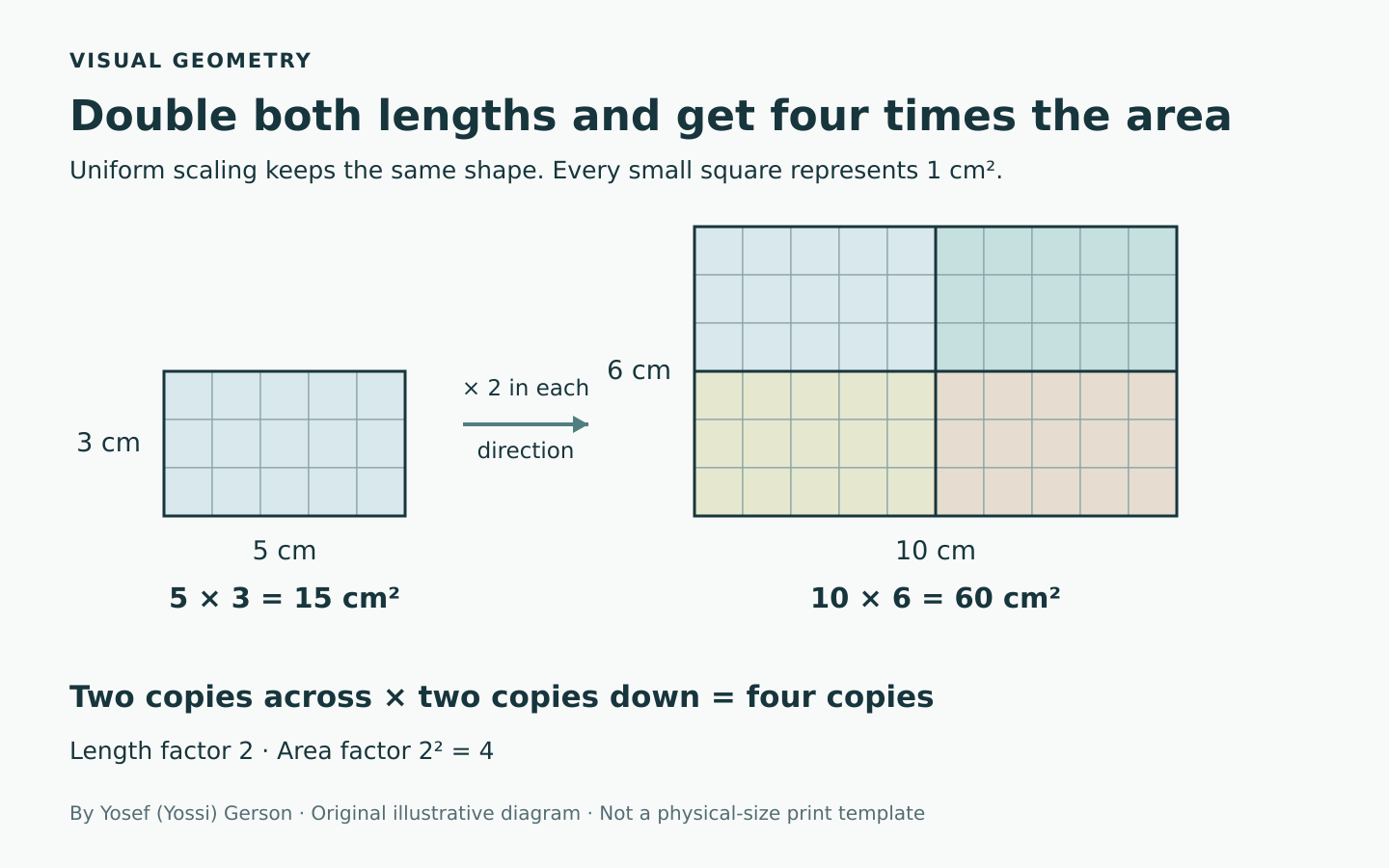
The new rectangle is six centimeters high and ten centimeters wide. Its area is 60 square centimeters, compared with 15 for the original. Every length doubled, but the area grew by a factor of four.
A diagram makes the extra factor visible. Two copies of the original fit across the new rectangle, and two fit down it. That makes two rows of two: four copies altogether.
Name the quantity that is growing
Length measures one direction. Area measures a surface in square units. Volume measures three-dimensional space in cubic units. These quantities respond differently when a shape is enlarged.
For a rectangle, area is width multiplied by height. Doubling both introduces two factors of two:
Original area: 5 cm × 3 cm = 15 cm².
Enlarged area: (2 × 5 cm) × (2 × 3 cm) = 4 × 15 cm² = 60 cm².
The outside boundary behaves differently. The original perimeter is 2 × (5 + 3), or 16 centimeters. The enlarged perimeter is 2 × (10 + 6), or 32 centimeters. Perimeter is a length, so it doubles.
An instruction such as “make it twice as large” leaves an important choice unresolved. Twice the width, twice every length and twice the area do not mean the same thing.
Keep the shape the same
Uniform scaling multiplies every corresponding length by the same positive factor. It preserves the shape. OpenStax's similar-figure explanation describes this relationship through equal corresponding angles and proportional side lengths.
If that length factor is k, the area factor is k × k, usually written k². The Open University's explanation of scaling areas and volumes develops the same distinction between length, area and volume.
For a triangle, both base and height scale by k, so its half-base-times-height area also gains two factors of k. For a circle, multiplying the radius by k changes its area from πr² to π(kr)², again multiplying area by k².
The condition matters. If only the width of a rectangle doubles while its height stays fixed, its area doubles. That rectangle has been stretched in one direction rather than enlarged uniformly.
Check more than one scale factor
Here are three enlargements or reductions of the same 5-by-3-centimeter rectangle:
| Length factor | New dimensions | Area | Area compared with original |
|---|---|---|---|
| 0.5 | 2.5 cm by 1.5 cm | 3.75 cm² | One quarter |
| 1.5 | 7.5 cm by 4.5 cm | 33.75 cm² | 2.25 times |
| 2 | 10 cm by 6 cm | 60 cm² | Four times |
A factor of 1.5 means each length grows by 50 percent. The area becomes 2.25 times the original, which is a 125 percent increase. “Times the original” and “percent increase” use different starting points: the increase leaves out the original amount.
For another worked example of choosing the right baseline, read Before You Compare Two Numbers, which separates counts, percentages and percentage-point changes.
The same care applies to shrinking. Halving both dimensions leaves one quarter of the area, a 75 percent reduction rather than a 50 percent reduction.
Work backward from a target area
Suppose you want twice the area while keeping the same shape. The length factor must satisfy k² = 2. Its positive value is the square root of two, approximately 1.414.
Multiply both original dimensions by that factor. The five-centimeter side becomes approximately 7.071 centimeters, and the three-centimeter side approximately 4.243 centimeters. Using the exact square-root factor gives an area of exactly 30 square centimeters. Rounded dimensions produce a small rounding difference.
This is why increasing both lengths by 100 percent overshoots a request for a 100 percent increase in area. The first operation quadruples the area; the second asks only to double it.
Add a third dimension carefully
A box introduces depth. If length, width and height all double, its volume gains three factors of two and becomes eight times as large.
A 2-by-3-by-5-centimeter rectangular box has a volume of 30 cubic centimeters. A 4-by-6-by-10-centimeter box has a volume of 240 cubic centimeters.
If only its length and width double while its height stays fixed, the volume grows by four, not eight. The three-factor rule applies only when all three dimensions scale together. Geometry alone does not establish how a real object's strength, cost or performance will change.
A short scaling worksheet
Before calculating, fill in these lines:
- Quantity wanted: length, perimeter, area or volume.
- Original dimensions and their units.
- Dimensions that change and dimensions that stay fixed.
- Whether all lengths share the same scale factor.
- Predicted result, with square or cubic units where appropriate.
Then check the result by calculating from the new dimensions directly. For the first rectangle, multiplying 10 by 6 agrees with multiplying the original area, 15, by four.
The two routes should agree. When they do not, look for a missing dimension, a changed shape, a unit mismatch or a rounded value. A picture and a direct multiplication often reveal the mistake faster than another formula.