You explain the problem. Someone sends you the help page you already tried. You explain it again. A new agent joins and asks you to start from the beginning.
At that point, writing a longer message is tempting. So is asking for a manager before anyone has established what needs to happen. A more useful move is to make the case easy to pick up: what failed, what you already tried, and what action you need next.
Here is a way to do that, with messages you can adapt. The delivery example below is hypothetical. These scripts help organize a request; they do not guarantee a particular outcome or override a company's policies.
Send a case summary, not the whole story
Imagine a delivery marked complete, but the delivery photo shows a doorway that is not yours.
A message such as “My package never came, this is ridiculous, and nobody is helping” explains the frustration. It leaves several practical questions unanswered.
Try this instead:
Order [reference] is marked delivered on [date], but I haven't received it. The delivery photo shows a doorway that isn't mine. I've checked [the locations you actually checked]. Please review the photo and tell me the next step for a possible delivery to the wrong address. I've attached the relevant screenshot.
Notice the boundary: it describes what you can establish. It does not claim the driver stole the package or that the company has agreed to replace it.
Give the support team the reference number they need through its official support channel. Leave out unrelated personal details. If you share an example publicly, remove addresses, account details and identifying information from screenshots first.
Make the requested action visible
“Please help” is understandable, but it does not identify what would move the case forward. “Please review the delivery photo” does.
The action depends on the problem:
| Situation | A useful next request |
|---|---|
| The instructions don't match your screen | Ask for the steps for your device or version, identifying the point where the screens differ |
| You've completed the suggested troubleshooting | Give the actual result and ask what should be checked next |
| A promised follow-up has not arrived | Refer to the previous commitment and ask for the current status and next update |
| The agent cannot handle the issue | Ask which team can review it and whether the case notes can go with the transfer |
Choose one immediate action. A message demanding an investigation, replacement, refund and apology all at once can make it harder to establish the next step.
When you get the same instructions again
Reply to the instruction itself. Say when you tried it and what happened.
I completed [step] on [date]. The result was [specific result], and the problem is still [specific problem]. Is there a different check we should try, or does this need review by another team?
If the agent explains that a step must be repeated for a particular reason, consider that explanation. The aim is to avoid repetition without a purpose, rather than refuse every repeated question.
Escalate the task, not the argument
“Get me your supervisor” may lead to another person with the same tools. Ask what needs a different kind of review.
It sounds like you can't review the delivery photo from your side. Which team handles possible wrong-address deliveries? If you transfer this, please include the order reference, the photo issue and the checks already completed so I don't have to rebuild the case.
If the answer is a policy decision, ask for the applicable policy and any available review process. Rephrasing the same demand is unlikely to resolve a disagreement about the rule itself.
Before the conversation ends, close the loop
“We've escalated this” leaves a gap. Is someone investigating, or do they need something from you?
Ask:
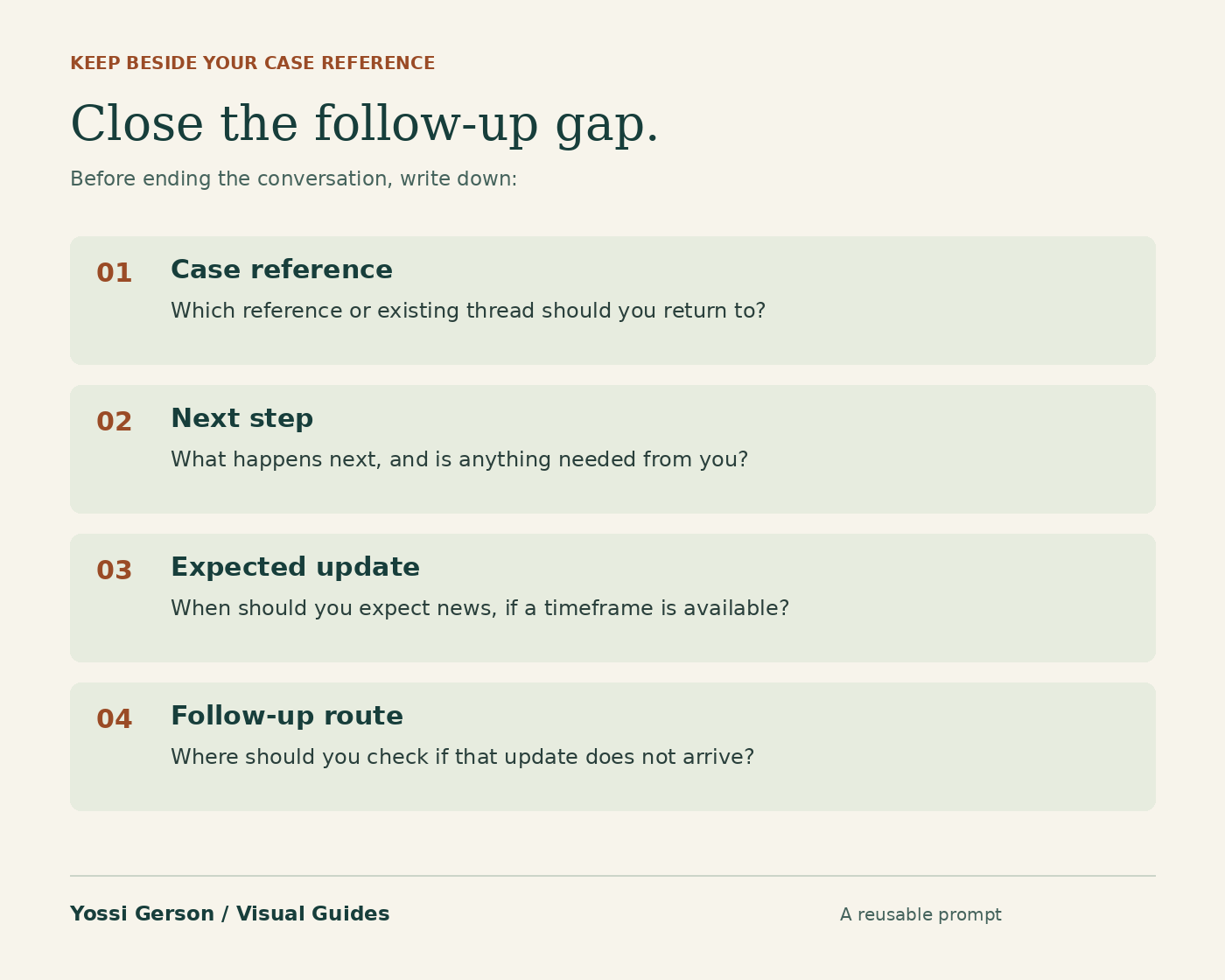
To make sure I've understood: what happens next, is anything needed from me, and when should I expect an update? Please also share the case reference, if one is available.
Save the answer. A short note is enough: case reference, date, next action, expected update and where to follow up. Keep any transcript the service provides. If no timeframe is available, ask how to check the status and whether a follow-up interval is recommended.
When the stated update time passes, return to that commitment:
Following up on case [reference]. On [date], I was told [next action] and to expect an update by [date]. I haven't received it. What is the current status, and is anything blocking the next step?
Use the existing thread or case where possible. If you need another channel, include the earlier case reference rather than leaving two teams to reconstruct separate histories.
Keep this four-line version
Before sending your next support message, fill in:
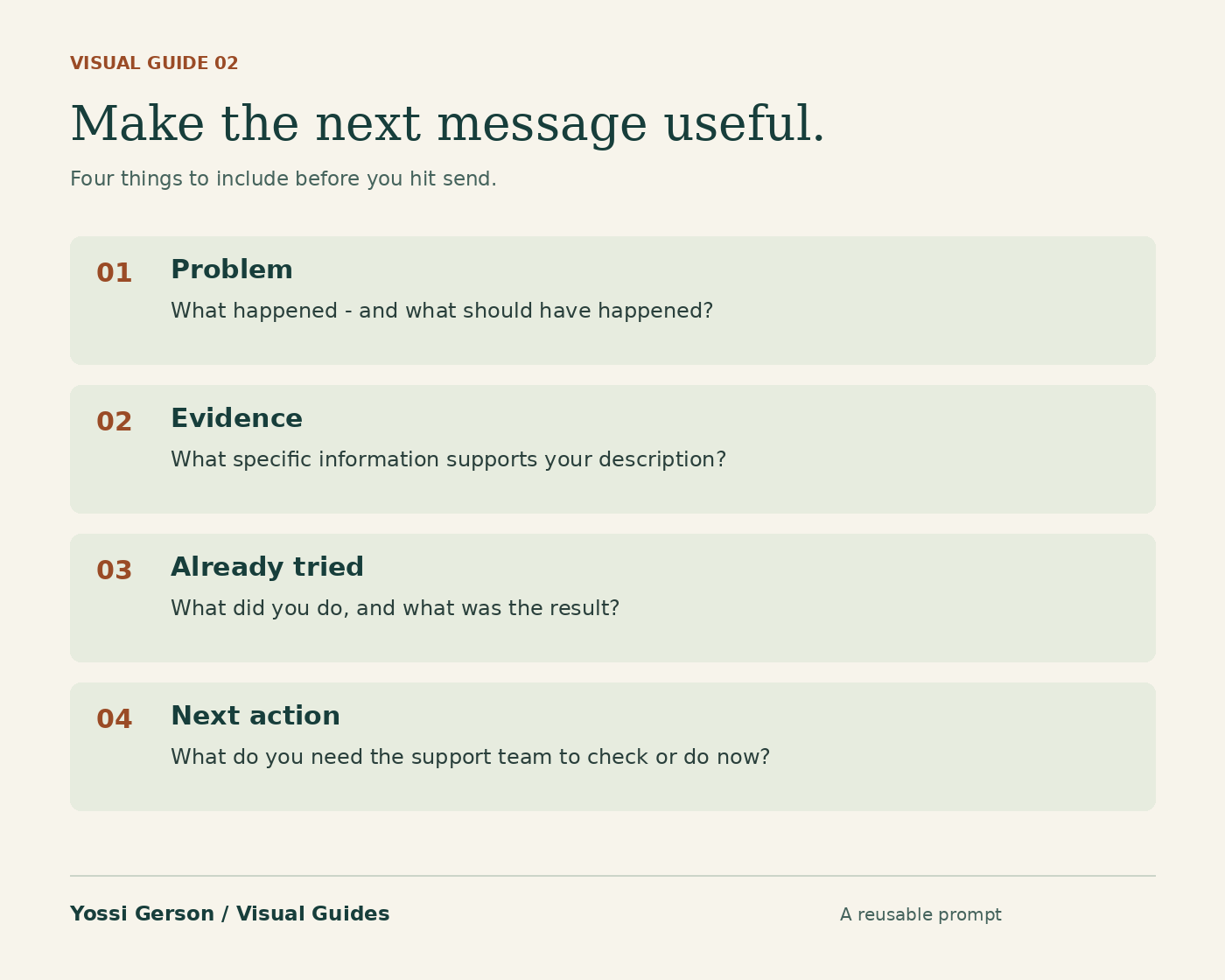
- Problem: What happened, and what should have happened?
- Evidence: What specific information supports that description?
- Already tried: What did you do, and what was the result?
- Next action: What do you need the support team to check or do now?
You do not need to sound like a lawyer or apologize for asking. A clear record gives the next person something they can act on - and gives you a better starting point if the first answer does not solve the problem.